
Taking Changes to Scale to Increase Student Access
By Rosanna Mucetti, Superintendent and Monica J. Ready, Assistant Superintendent of Instructional Support Services, Napa Valley Unified School District
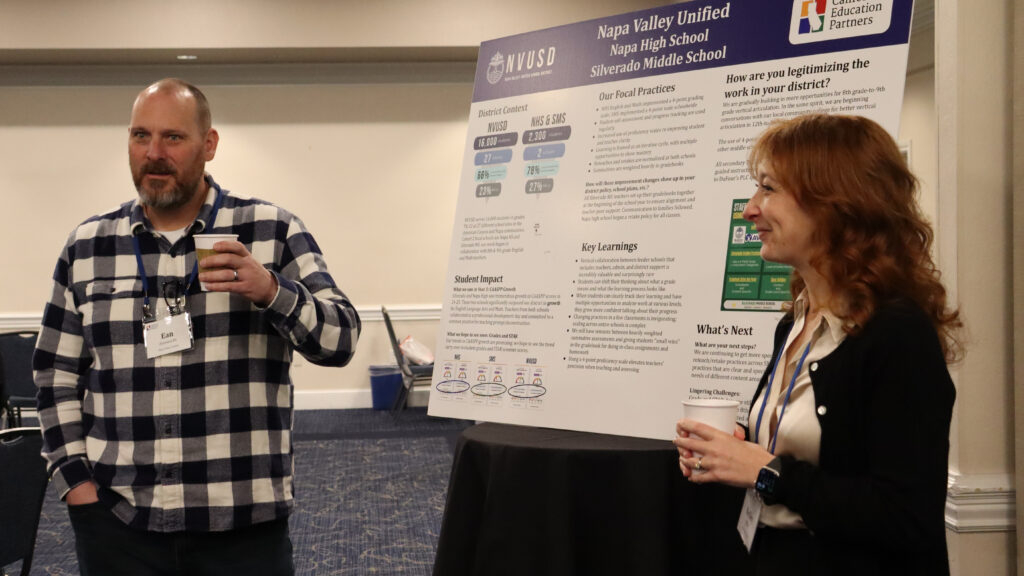
The transition from middle school to high school often marks the first major drop in momentum toward college readiness. Across California, nearly half of high school graduates fail to complete the A–G coursework with a C or above. This eliminates their opportunity to attend the University of California and California State University systems. At Napa Valley Unified School District (NVUSD), we saw that misaligned grading practices were one central barrier for students: When expectations varied by grade and classroom, and when grading prioritized compliance over demonstrated learning, students lost opportunities to demonstrate growth and recover from academic setbacks. The transition from eighth to ninth grade particularly highlighted these gaps, jeopardizing students’ ability to meet A–G requirements. Over 65% of our students come from socioeconomically disadvantaged backgrounds, and nearly one-fourth are English learners. The opportunities we provide are crucial for their post-secondary success.
Like a growing number of districts, Napa identified accurate grading as a necessary lever to close achievement gaps and improve A–G readiness. Our early reform efforts began during the pandemic, when disparities in outcomes widened, and urgency further intensified. Yet our early efforts lacked coherence: practices varied across schools, change rested with individual champions, and progress stalled under (understandable) skepticism and resistance.
After initial setbacks, we sought a partner with deep experience in system-level instructional change. Through peer recommendations, California Education Partners (Ed Partners) emerged as a trusted collaborator. What distinguishes our work with Ed Partners from our other efforts to address this persistent problem is a focus on systems coherence, capacity building, and continuous improvement—not one-off professional development or short-term initiatives. With our multi-year partnership, changes to grading practices have begun to take root and scale across our pilot sites.
Through a disciplined, system-wide effort, we moved from a handful of teachers working together to teachers at close to half of our secondary schools (and growing), aligning around a set of effective shared practices to improve student learning and outcomes.
Successful Pilots Create Demand
We started with two schools, one middle and one high — Silverado Middle School and Napa High School. The sites had an existing partnership through a COWELL Foundation grant and demonstrated readiness for collaboration. Napa High’s WASC report also underscored the need for greater consistency in grading, creating urgency and a clear context for change.
The first year was deliberately cautious. Teachers worried about midyear changes. District and school leaders emphasized trust-building and honest dialogue. Napa High School Principal Dr. Ean Ainsworth shared that:
“The foundation of any conversation about grading has to be a strong and trusting staff culture. Each conversation surfaces deeply held beliefs and philosophies about grading, which makes the work inherently messy. Napa High School is fortunate to have a staff willing to be honest and vulnerable with one another. That level of trust has allowed us to build greater accuracy and consistency in how we assess and communicate student learning.”
By year two, momentum accelerated. Empathy interviews with students and teachers revealed how inconsistent grading practices affected study habits, confidence, and growth opportunities. Napa High teachers led the way in interviewing; Silverado staff observed and then replicated the process. Through these interviews, Principal Anne Vallerga shared that:
“We had over thirty teachers and realized that we also had over thirty approaches to grading, weighting, and communicating progress. While each teacher’s system made sense in isolation, for students and families it created confusion about what letter grades actually reflected. When we met in PLCs, we weren’t talking apples to apples.”
The schools discovered that, while each teacher approached grading with care and intention, the lack of alignment across classrooms created unintended barriers for students and families. Deeply listening to students on this topic heightened the team’s urgency.
The pilot focused initially on mathematics and English Language Arts (ELA). Departments across both sites aligned professional learning, blending professional learning days and selecting a small set of high-leverage practices to implement consistently across middle and high school. They leveraged existing proficiency scales to calibrate rigor in lessons and assessments, analyzed student work collaboratively, and committed to intentional reteach and retake cycles to support students’ ongoing learning.
The second year delivered clear gains in students’ understanding of the standards: CAASPP data for our high school students showed more than 11 percentage points of growth in ELA and more than 7 points in mathematics, meeting or exceeding standards. As progress became visible, interest grew beyond the original two schools. A second pilot with Redwood Middle School and Vintage High School launched, with American Canyon Middle School and American Canyon High School slated to join in 2026-2027, and professional learning communities (PLCs) from across the district continue to spread the approach.
Board Alignment
Sustainable district change requires governance and instructional leadership to be aligned around shared priorities. NVUSD’s board has consistently prioritized closing achievement gaps and expanding access to postsecondary opportunities for historically marginalized students. This clarity framed grading equity not as a stand-alone initiative but as a lever tied to outcomes the board already champions.
Throughout the pilot, district leaders monitored progress toward board-level goals. This alignment protected the work from initiative fatigue and ensured the time, attention, and resources needed for meaningful implementation.
Strategy and Consistency: Moving from Tactics to System
Grading reform is a system-level change rather than simply a collection of classroom practices for individual teachers to implement. Instead of relying on isolated professional development sessions, an Ed Partners program manager guided pilot schools through a disciplined improvement process that built shared practices, strengthened cross-site alignment, and supported ongoing improvement.
This comprehensive approach was invaluable to a geographically isolated district like NVUSD, where opportunities to regularly collaborate with peer districts around complex challenges such as grading reform are limited. Working with a statewide partner like Ed Partners brought perspective beyond NVUSD and connected our work to improvement structures learned from districts across California, grounding the pilot in proven practices rather than trial and error.
As schools engaged in this work, educators quickly recognized that changes to grading practices necessitated deeper reflection on instructional coherence. As Silverado Middle School Principal Anne Vallerga observed:
“When teachers shifted to grading that reflected proficiency over completion and compliance, it compelled us to look deeply at our instruction. We had to ask whether our lessons were truly grade-level and standards-based, whether formative activities were aligned to mastery of specific skills, whether we were calibrated on how we assessed, and whether we were creating multiple opportunities for students to demonstrate progress after additional practice and coaching.”
Ed Partners supported alignment between instructional practice and grading policy. Through coaching and facilitation, teams clarified how grading practices either support or constrain learning, prioritized summative assessments, and committed to meaningful opportunities for reteach and retake cycles. The overarching message was clear: grades should reflect mastery of standards, not mere compliance.
A hallmark feature of the improvement process was the introduction of “data dialogues” within school leadership teams and professional learning communities. Teams used these routines to examine student work and performance data, identify patterns, and set data-informed goals. This shift moved conversations from isolated classroom experiences to shared evidence that informed decisions across schools, departments, and grades, strengthening coherence at the critical eighth-to-ninth-grade transition.
By guiding pilot schools through a coherent improvement process, the partnership made changes to grading practices not only implementable, but scalable across the district.
Include Every Teacher to Reach Every Student
Our core aim is simple: ensure every student leaves high school with the maximum number of options for college and career within reach. Keeping students on track for A–G completion requires timely intervention within each semester to support student learning, consistency, and clarity across the secondary years.
Our district moved from intention to action through a disciplined improvement process that involved vertical teams of teachers and administrators working together. Our partnership with Ed Partners translated a complex, sometimes contentious issue, into concrete, repeatable practices that educators can implement and sustain. Most importantly, it shifted responsibility from individual classrooms to the system as a whole.
We turned a stubborn problem into scalable, lasting change. The structures we built—shared routines, aligned expectations, and data-informed iteration—provide a foundation as we continue to scale this and other improvements across our district.