
Sanger Unified’s Systems and Structures for Alignment
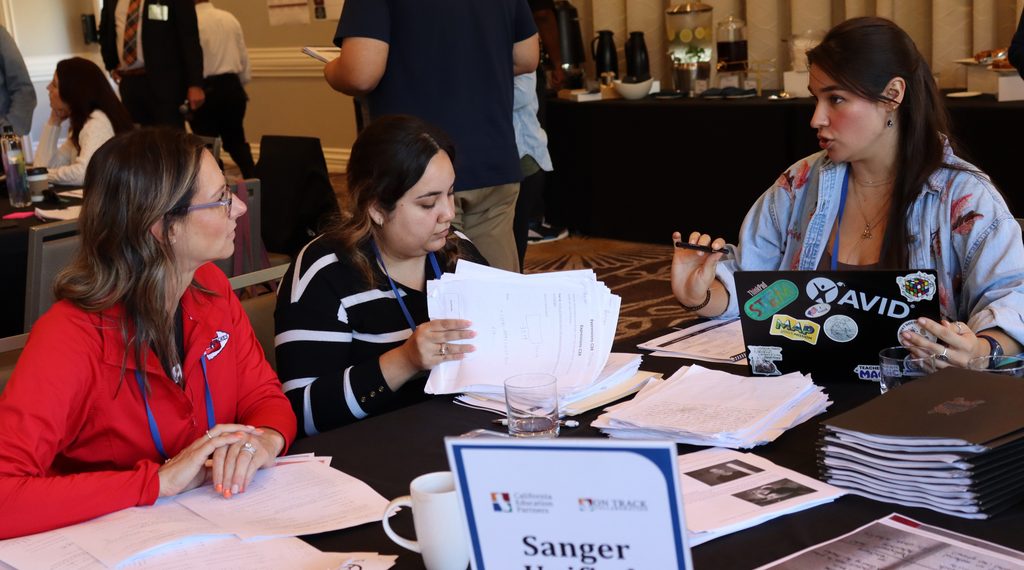
The Sanger On Track Improvement Team, composed of leaders across five secondary schools (Sanger High School, Sanger West High School, John F. Kennedy Middle School, Washington Academic Middle School, and Hallmark Academy), is focused on improving the practices that support student outcomes in mathematics. The district administrators, site administrators, Curriculum Support Providers, and TOSAs coordinate their efforts to support math teaching from middle to high school.
The Team’s goal is for students to be learning at grade level at a depth that not only allows them to access post-secondary education, but prepares them to thrive in whatever they choose to do after graduation. The team seeks to establish and maintain coherence across campuses focused on rigorous instruction and assessment, with feedback practices that lead to effective interventions and common grading practices. The team offers coaching supports with focused monitoring to ensure their efforts translate to improvements in instructional practices and student outcomes.
This year, the team is supporting an active curriculum adoption process that grapples with employing common effective instructional techniques and structures with unfamiliar materials. While teachers pilot curriculum, they seek to find and ensure a balance between the development of student understanding and procedural fluency using instructional practices that allow all students to grow and succeed.
Fortunately, Sanger Unified has robust and abundant structures that strengthen and reinforce each other along with increasingly aligned resources and professional learning opportunities. The layers of structurally rich support allow teams to collaborate across sites, supported by the united efforts of their people as they have strong multi-site agreements around pacing and assessment use. Their efforts are focused on improving student outcomes through the use of instructional practices that promote deep student reasoning, justification, writing, and collaboration. Instructional practices are focused on increasing the richness and use of feedback, with teachers regularly gathering and using formative evidence to guide instruction through exit tickets, whiteboards, common formative assessments, rubrics, use of error analysis, and observation of student work.